


Here is a comprehensive API Technical Writing Documentation User Guide for Using Open Source in Cybersecurity, designed to help technical writers and developers create clear, secure, and effective API documentation focused on open source cybersecurity tools and frameworks.
1. Introduction
This guide provides best practices for documenting APIs related to open source cybersecurity projects. It covers how to write clear, secure, and developer-friendly documentation that facilitates adoption, integration, and security compliance.
Open source cybersecurity APIs often expose sensitive functionality and data, so documentation must emphasize security best practices alongside usability.
2. Understand Your Audience
Developers and Security Engineers: Focus on clarity, practical examples, and security considerations.
Compliance Auditors: Provide clear descriptions of security features and compliance measures.
End Users: Include conceptual overviews and tutorials to ease onboarding.
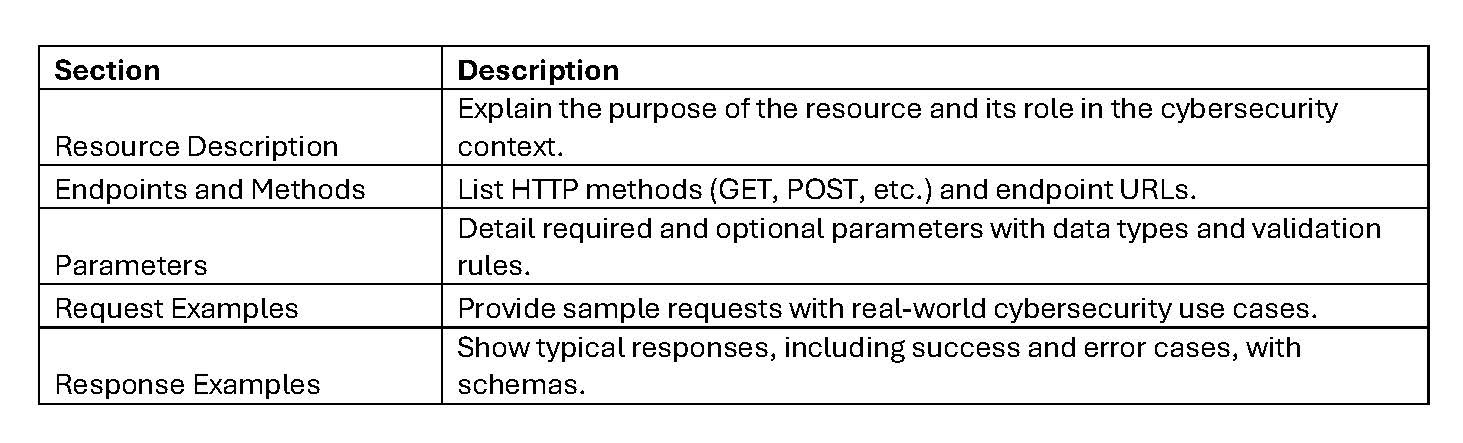
3. Structure of API Documentation
Each API endpoint should be documented with the following key sections:
4. Use OpenAPI Specification
Adopt the OpenAPI Specification (OAS) to standardize your API descriptions.
Use tools like Swagger UI, Stoplight, or Redocly to generate interactive, user-friendly documentation.
Include security schemes in your OpenAPI spec, such as OAuth2 flows or API keys.
5. Emphasize Security Best Practices in Documentation
Given the cybersecurity context, highlight security measures clearly:
Authentication & Authorization:
Use OAuth2, OpenID Connect, or JWT tokens.
Explain how to obtain and use tokens securely.
Describe role-based or attribute-based access control (RBAC/ABAC).
Data Encryption:
Document that all API communications use HTTPS/TLS.
Mention encryption of sensitive data at rest and in transit.
Input Validation & Sanitization:
Specify input validation rules to prevent injection attacks.
Warn users about sanitizing inputs and outputs.
Rate Limiting & Throttling:
Describe limits to prevent abuse and DoS attacks.
Logging & Monitoring:
Explain how API activity is logged and monitored for security incidents.
Endpoint Security:
Advise on minimizing exposed endpoints and using API gateways or firewalls.
6. Provide Getting Started Guides and Tutorials
Include step-by-step instructions on how to:
Register and obtain API credentials.
Authenticate and authorize requests.
Make basic and advanced API calls.
Handle errors and status codes.
Use cybersecurity scenarios, such as scanning for vulnerabilities or managing threat intelligence, to contextualize examples.
7. Testing and Validation
Encourage users to test API calls using interactive documentation or tools like Postman.
Document how to set up test environments and obtain test credentials.
Regularly validate documentation against the live API to ensure accuracy.
8. Continuous Updates and Compliance
Keep documentation up to date with API changes and emerging cybersecurity threats.
Include sections on compliance with relevant standards (e.g., GDPR, NIST) and how the API supports them.
9. Tools and Resources
Use OpenAPI editors: Swagger Editor, Stoplight Studio.
Generate interactive docs with Swagger UI, Redocly.
Use API gateways for security enforcement.
Leverage automated tools like Blackbird for spec generation and validation.
10. Summary Checklist for Cybersecurity API Documentation
Clearly describe each API endpoint with examples.
Document authentication and authorization flows in detail.
Emphasize encryption and secure communication protocols.
Include input validation and error handling guidelines.
Provide tutorials with cybersecurity use cases.
Use OpenAPI spec for standardization and automation.
Test documentation against live APIs regularly.
Highlight compliance and data privacy measures.
Update docs continuously as APIs evolve.
By following this guide, technical writers can create comprehensive, secure, and user-friendly API documentation that supports open source cybersecurity projects and helps developers integrate securely and efficiently.